The bio-pharmaceutical industry demands exacting detail in design, development,
operation, quality, and just about every other aspect of the business.
As such, there is a degree of specialty in most every field of endeavor
in this industry. This book was developed to try to accelerate the learning
process for the application of automation in bio-pharmaceuticals. The
authors' hope is that the content of this book will help scientists and engineers
continue to contribute to the manufacture of high-quality medicines
via improving process control and on-line availability of information
while reducing costs, cycle time, and process variability.
Some readers may come into this industry with previous automation
experience. Others may be in the bio-pharmaceutical industry, but have
limited automation knowledge. In either case, the authors strived to bring
the reader to a more thorough understanding of the topics.
This book is supplemented by a wealth of reference materials in the industry.
Each chapter contains a list of recommended reference materials.
 TABLE OF CONTENTS
 Chapter 3.11 - Bioprocess Filtration
Process Description and Challenges
Often, the separation of desired components from complex biological systems
accounts for more than half of the process equipment. Filtration is
one of the most common methods for separating components based on
size. For example, cell membranes and other large, insoluble components
may be separated through microfiltration or ultrafiltration processes.
There are many challenges with filtrations. As they are used, filters may
become partially clogged with separated materials. Delicate filter membranes
may add special pre-wetting sequences and limiting of differential pressures.
Control strategies may need to balance between flow and pressure
requirements.
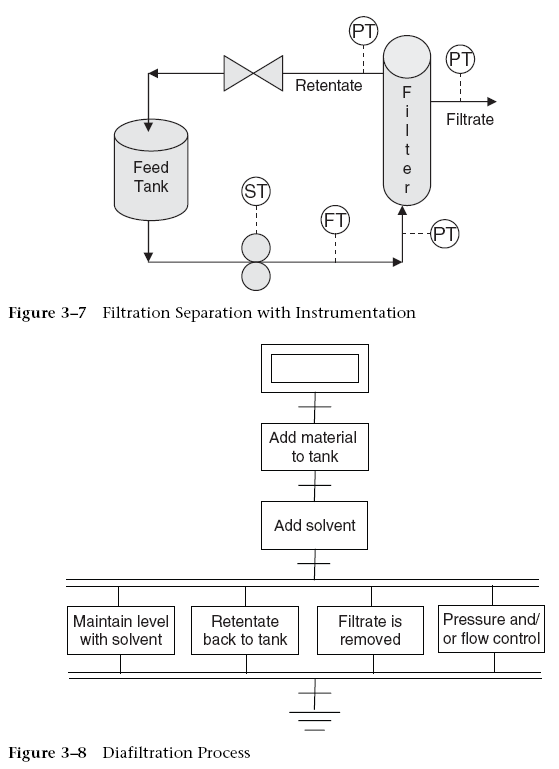
Diafiltration processes (see Figures 3-7 through 3-10) are often used to
cleanse a product while concentrating. Maintaining accurate mass balance
of diafiltration fluids is important to product and process repeatability.
Typical Instrumentation Requirements
Upstream and downstream pressure measurements are critical to bioprocess
filtration. Most often, these measurements are also combined to show
the differential pressures across a filter.
Flow measurements may be desirable as well, and may often be a key controlled
variable. Mass flow meters are most often used.

Control Strategies
Communications
Communications for upstream and downstream operations are typically
sufficient.

Sequences
Filter membranes may be delicate materials. Filters left to dry out may be
damaged. So, a pre-wet sequence may be used to wet filter materials while
waiting for product processing.
Also, cleaning and sanitization of filter systems may be accomplished by
chemical means, rather than the harsh CIP/SIP cycles.
The filtration sequence itself is typically semi-continuous. It is normal for
filters to plug slowly during processing. So filtration operations may follow
a pre-programmed ramp or curve for pressure and/or flow control. In
some cases, the control strategy may shift between pressure and flow controls
for the most effective processing.
At the completion of product filtration, there may be additional flush
sequences to try to extract the maximum product yield. This is particularly
true when filtering high-value product, near the end of processing.
Control Loops
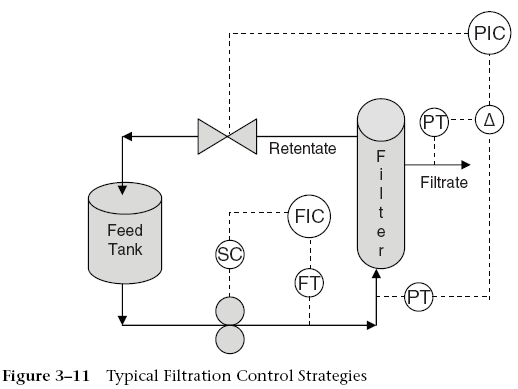
There are many combinations of flow, pressure, and differential pressure
controls used in filtration. Figure 3-11 shows a few typical control strategies.
Differential pressure control across the filtration membrane serves two
purposes. First, a higher differential pressure creates a higher driving force
for the separation. Counteracting this is the need to protect the filter
membrane itself by not exceeding differentials across the membrane.
One of the proposed strategies is to use a minimum selector between DP
control and flow control. With this technique, as the filter plugs and the
DP rises, the filter flow will be cut back to prevent filter damage.
Calculations
Diafiltration processes involve the continuous flushing of materials
through a filter. Process criteria are based on a number of volume
exchanges. Depending on process configuration, this may involve a continuous
calculation/integration of the flow of flush materials.
Tuneables
Many process tuneables may be required for scale-up of a filtration process.
Tuneables may include:
- Ramp rates for pressures and/or flows
- Maximum allowable pressure or flow
- Volume required to fill or "prime" the filter system