The bio-pharmaceutical industry demands exacting detail in design, development,
operation, quality, and just about every other aspect of the business.
As such, there is a degree of specialty in most every field of endeavor
in this industry. This book was developed to try to accelerate the learning
process for the application of automation in bio-pharmaceuticals. The
authors' hope is that the content of this book will help scientists and engineers
continue to contribute to the manufacture of high-quality medicines
via improving process control and on-line availability of information
while reducing costs, cycle time, and process variability.
Some readers may come into this industry with previous automation
experience. Others may be in the bio-pharmaceutical industry, but have
limited automation knowledge. In either case, the authors strived to bring
the reader to a more thorough understanding of the topics.
This book is supplemented by a wealth of reference materials in the industry.
Each chapter contains a list of recommended reference materials.
 TABLE OF CONTENTS
 Chapter 3.3.3 - Control Strategies for CIP
Communications
The CIP automation system must be in communication with the processes
being cleaned. In many systems, the controller for CIP may be separate
from those being used by the other parts of the process. The
communications must include:
- Ensuring that both systems are ready prior to starting
- Passing parameters for confirmation of cleaning
- Communications of completeness of the CIP cycle
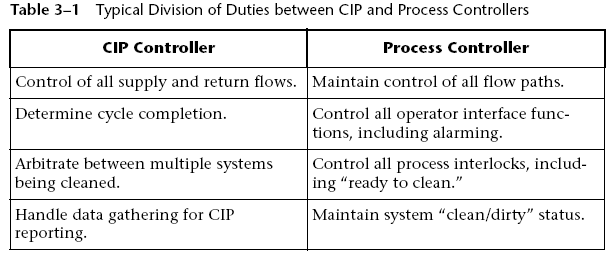
One typical way to divide the duties between the CIP controller and the
process controller is shown in Table 3-1.
Sequences for CIP
The key sequences used for CIP are:
- Preparation of Cleaning Solution
- Distribution of Cleaning Solution
Key design decisions to be made include:
- Will the system be allowed to distribute fluid to multiple systems
at once? - How will arbitration between systems be handled?
- What are the specific completion criteria for each step?
Control Loops in CIP Systems
The control loops used within CIP systems are generally simple, independent,
PI or PID control loops. The only real complexity is determining the
expected state of each control loop during each part of the CIP cycle.
Flow control and pressure control loops are generally PI control loops
handled with variable-speed drives on the CIP supply and/or return
pumps.
More advanced ratio-control strategies can be employed in the preparation
step to ensure precise control of the final cleaning fluid concentration.
Temperature control loops are generally handled using PID controls on
jacketed tanks during preparation and storage, and heat exchangers at the
point-of-use for cooling the fluids.
Tuneables for CIP
It has been noted above that control loop setpoints must change from step
to step in the process. During "cleaning development," these setpoints are
often adjusted frequently. Those doing the cleaning development treat
them as "tuneable" parameters. Once these parameters are established,
they must be "locked down" for use by operators. Again, integrated batch
management software can help simplify this work.