The bio-pharmaceutical industry demands exacting detail in design, development,
operation, quality, and just about every other aspect of the business.
As such, there is a degree of specialty in most every field of endeavor
in this industry. This book was developed to try to accelerate the learning
process for the application of automation in bio-pharmaceuticals. The
authors' hope is that the content of this book will help scientists and engineers
continue to contribute to the manufacture of high-quality medicines
via improving process control and on-line availability of information
while reducing costs, cycle time, and process variability.
Some readers may come into this industry with previous automation
experience. Others may be in the bio-pharmaceutical industry, but have
limited automation knowledge. In either case, the authors strived to bring
the reader to a more thorough understanding of the topics.
This book is supplemented by a wealth of reference materials in the industry.
Each chapter contains a list of recommended reference materials.
 TABLE OF CONTENTS
 Chapter 3.10.2 - Control Strategies
Communications
Most bioreactors are sufficiently complex to warrant a dedicated controller.
However, they must communicate with upstream media and reagent
supplies, utility supplies, and downstream processing units. You must take
care to design, test, and validate these communications thoroughly.
Even if you do not use Flexible Batch Management software, it is a good
idea to design the bioreactor control system with a "state management"
concept in mind. That is, the system should be able to report its current
state, including each of the following states:
- In_CIP
- Clean (with time remaining)
- In_SIP
- Sanitized (with time remaining)
- Charging (with media)
- Charged
- Inoculating
- Reacting/Fermenting/Growing
- Inactivation
- Harvesting

Sequences
CIP and SIP can be rather complex sequences with a bioreactor. With several
flow paths and lines of various sizes, you must pay careful attention
to the design of CIP and SIP sequences.

Charging media can be very simple or quite complex, depending on process
requirements. If the growth media is prepared within the bioreactor,
then weight or volume measurement must be very precise. If media is prepared
elsewhere, then you may need a series of "buffer chase" or "airblow"
sequences to ensure that all media is transferred into the vessel.
Most of the vessel control loops must be activated and stabilized prior to
the inoculation. You will need to establish criteria for determining when
the system is ready for introduction of seed. It is likely that some of the
"readiness criteria" will be off-line measurements, so you will probably
need some level of operator confirmation or prompting.
During growth phases, control loops may follow pre-defined ramps or setpoint
changes to handle the changing cell concentration, volume, and
life-cycle of the cell culture. Again, clear up-front definition of the criteria
for these changes will help to ensure the success of the automation.
Inactivation may require a careful sequence of manual and automated
events, to prevent contamination and/or release of bioreactor contents.
Operator prompts and interlocks are highly advised during this critical
operation. Also, some control loops, such as pH control, may be disabled,
while others, such as temperature and agitation, may be maintained.
During harvest, the bioreactor is drained of its contents. If the cells or
product are fragile, then care must be taken to avoid damage during this
phase. This may require careful automation of vessel agitation, reducing
agitation speed, or stopping agitation completely as the liquid level drops
toward each set of agitator blades.
Control Loops
Bioreactors require many different control loops to maintain a proper
environment for the desired organism. Even slight changes in temperature,
pH, or dissolved gas concentrations can lead to dramatic changes in
yield. Some of the key control loops for bioreactors are discussed here.

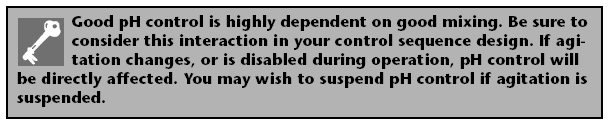
pH control is extremely important to most bioreactors. As most organisms
grow, acid is produced. This requires some form of base addition to maintain
a constant pH. Some bioreactors have two-sided pH control, allowing
for addition of either acid or base to maintain the desired pH.
Acid or base addition in bioreactors is often accomplished with metering
pumps. It is important to locate the metering pump as close to the injection
point as possible [3.4].
Control of dissolved gases brings many challenges. As mentioned above,
many cell cultures are shear-sensitive, and cannot be heavily agitated.
Sensors may also be delicate, and must be capable of being cleaned and
sanitized. Furthermore, gas consumption changes, often exponentially,
with cell growth. This means that dissolved gas control must have a high
degree of rangeability.
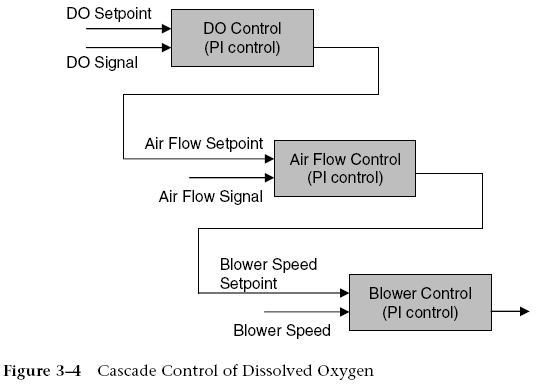
As an example, we will choose Dissolved Oxygen (DO) control. DO control
may be handled by a combination of air flow, agitation, and air pressure
control. For simple DO and air flow control, a cascade arrangement,
as shown in Figure 3-4, can be used. Since the agitation is the fastest-
responding element, it is chosen as the innermost control loop of the
cascade.
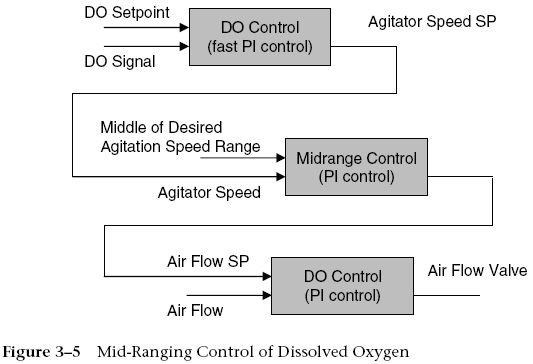
When dealing with shear-sensitive organisms, it may be desired to keep agitation
within a limited range. In this case, a form of mid-ranging control is
suggested. Agitation can be used within specified limits. Air flow is adjusted
to keep the agitation within its specified range. The mid-ranging control
scheme is shown in Figure 3-5.
Pressure control is typically accomplished by control of a vent pressure.
The pressure control valve is often located downstream of a containment
filter. If the filter becomes plugged or wet, pressure control will become
sluggish. Make sure that you have an alternate means of relieving pressure.
Whenever you have agitation and proteins, you are likely to have foam.
Foam can wreak havoc with level control and pressure control. Antifoam
is often added using pen-loop control.
Bioreactor temperature control may be accomplished through the use of a
jacketed vessel, through an external heat exchanger, or (rarely) through
direct steam injection. Jacket controls are also dependent on agitation,
and the dynamics of the control loop may change dramatically as the biomass
(and therefore viscosity) and agitation rates change. It is recommended
that you choose sufficiently robust controller tuning to ensure
stable temperature performance throughout the full range of operation.

Calculations
Most fermentations and other bioreactions remain very complex processes.
There are many interactions between variables, and knowledge of the interactions
is continually growing. Because of this, experimental data is often

desired, even from on-going production-scale equipment. It is recommended
that you design the control system with the ability to export data
for analysis, and to allow calculation of new parameters for monitoring.
Of course, code modifications would require re-validation, so it may be
simpler to collect large amounts of historical data, and then allow experimental
calculations to be based on the stored process history.
Tuneables
Scale-up of bioreactors is tricky business, and requires carefully planned
experimentation. If you are designing a bioreactor at a new scale, it is wise
to allow key parameters to be easily adjusted during scale-up runs. In
addition to setpoint adjustments, it is recommended that the following
parameters should be adjustable:
- Ramp rates
- Fill volumes
- Agitation strategy
- Parameter values for transitions between phases