The bio-pharmaceutical industry demands exacting detail in design, development,
operation, quality, and just about every other aspect of the business.
As such, there is a degree of specialty in most every field of endeavor
in this industry. This book was developed to try to accelerate the learning
process for the application of automation in bio-pharmaceuticals. The
authors' hope is that the content of this book will help scientists and engineers
continue to contribute to the manufacture of high-quality medicines
via improving process control and on-line availability of information
while reducing costs, cycle time, and process variability.
Some readers may come into this industry with previous automation
experience. Others may be in the bio-pharmaceutical industry, but have
limited automation knowledge. In either case, the authors strived to bring
the reader to a more thorough understanding of the topics.
This book is supplemented by a wealth of reference materials in the industry.
Each chapter contains a list of recommended reference materials.
 TABLE OF CONTENTS
 Chapter 3.14 - Waste Containment and Processing Systems
Process Description and Challenges
Waste containment and processing systems are relatively simple to control.
A typical "kill system" receives liquid wastes from the facility, reduces viability
through either chemical addition, burning, or direct steam injection,
then cools the waste product for further downstream processing.
Process wastes may be considered hazardous, and must be handled with
care or processed according to specific regulations. Because of the proteinaceous
nature of the waste products, waste systems must be designed to
handle the inevitable build-up of waste product.
Since the waste system may handle waste streams from multiple processing
areas, you may need surge capacity, and a way to schedule the waste
processing from different process areas.
Typical Instrumentation Requirements
Instrumentation requirements are generally quite simple. Temperature
and level or weight controls are usually sufficient, although you may need
some form of totalized flow measurement to verify the addition of chemical
disinfectants.
Physical design and material selection is very important. Some disinfectant
chemicals, such as Phenol, are extremely corrosive. Instrument materials
must be selected with care.
Also, as mentioned above, the proteinaceous nature of the waste product
means that you should take extra care in the design of instrument geometry
to avoid trapping and build-up of materials. Be sure to include design
of clean-out ports and carefully consider access to these instruments. They
are in a difficult service, and are more likely than most to have maintenance
issues.
Level measurement can be especially difficult in these conditions. You
may consider the use of weigh cells instead of direct level measurement to
determine vessel contents.
Control Strategies
Communications
Communications between the waste system and the upstream process
areas must be put in place. The communications can be quite simple. Typically,
all that is required is a "ready to receive wastes" signal to be sent to
the requesting process areas.
Of course, you will also need some form of batch reporting to document
the operation of the waste system. This could be handled manually. However,
since the kill system will most likely run without any operator intervention,
an automated reporting feature should be considered.

Sequences
For a temperature-based kill system, a typical sequence of operation is:
- Receive waste materials
- Hold materials
- Pre-heat
- Hold at temperature
- Cool-down
- Transfer processed waste
For chemical-based kill systems, the sequence may be:
- Receive waste materials
- Hold materials
- Add chemical disinfectant
- Hold at temperature
- Transfer processed waste
Control Loops
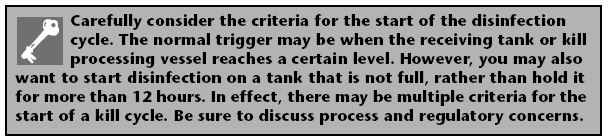
A single temperature control loop is sufficient for temperature-based kill
systems. Temperature control is most commonly handled by direct steam
injection, but may also be handled by vessel jacketing, or by circulating
waste fluids through a heat exchanger. In any case, the temperature must
be held at or above a designated setpoint for some period of time.
If the waste must be cooled, it is typically not done through a control loop.
The process is simply cooled until it reaches a completion temperature.
Calculations
Some facilities may want a confirmation of kill time only. Others may
wish to see a more detailed Fo calculation. Consult with process engineers
to determine the requirements for your process.
Tuneables
There is little or no process tuning required on most waste processing systems.
During commissioning phases, you may want to allow adjustment
of temperature setpoints and hold time durations.