The bio-pharmaceutical industry demands exacting detail in design, development,
operation, quality, and just about every other aspect of the business.
As such, there is a degree of specialty in most every field of endeavor
in this industry. This book was developed to try to accelerate the learning
process for the application of automation in bio-pharmaceuticals. The
authors' hope is that the content of this book will help scientists and engineers
continue to contribute to the manufacture of high-quality medicines
via improving process control and on-line availability of information
while reducing costs, cycle time, and process variability.
Some readers may come into this industry with previous automation
experience. Others may be in the bio-pharmaceutical industry, but have
limited automation knowledge. In either case, the authors strived to bring
the reader to a more thorough understanding of the topics.
This book is supplemented by a wealth of reference materials in the industry.
Each chapter contains a list of recommended reference materials.
 TABLE OF CONTENTS
 Chapter 4 - People, Projects, and Profitability
This chapter addresses some of the key "soft" issues surrounding automation
applications in bio-pharmaceuticals. Left unattended, these issues
can cost a lot of time and effort to resolve. It is at least as important to pay
attention to these issues as it is to select the right instrumentation and/or
control strategy. Furthermore, documenting and following procedures
will help immeasurably in the validation phase and in operating and
maintaining the facility.
The chapter is divided into three sections: People, Projects, and Profitability.
The focus will be on these factors as they relate to automation and
process control. For example, we will not talk about all of the responsibilities
of operations, but we will focus on the responsibilities that relate to
or are driven by automation.
In the "People" section we discuss roles and responsibilities and qualifications
for personnel involved in implementing process control and automation
in a cGMP facility.
In the "Projects" section we discuss aspects of automation project management
that help to ensure a successful automation application. This
chapter also identifies more in-depth reference materials to help establish
specific procedures for project management.
In the "Profitability" section we discuss some ways to conserve money in
the automation application. Some of these ideas are oriented toward saving
up-front capital costs, and others can help to save on-going operations
expenses. Use this section to help find savings in design, implementation,
and maintenance.
We will also introduce some topics related to procedures. Procedures are
tightly linked with the validation practices discussed in Chapter 5.
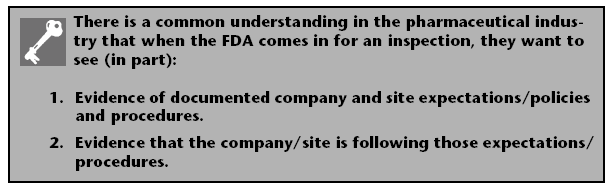
It is important to recognize that each company has defined its own roles,
responsibilities, policies, and procedures. These company-specific and
site-specific policies must be followed. The advice in this book does not in
any way replace company policies. The references listed at the end of
Chapters 4 and 5 may be used to help establish or interpret company
policies.