The bio-pharmaceutical industry demands exacting detail in design, development,
operation, quality, and just about every other aspect of the business.
As such, there is a degree of specialty in most every field of endeavor
in this industry. This book was developed to try to accelerate the learning
process for the application of automation in bio-pharmaceuticals. The
authors' hope is that the content of this book will help scientists and engineers
continue to contribute to the manufacture of high-quality medicines
via improving process control and on-line availability of information
while reducing costs, cycle time, and process variability.
Some readers may come into this industry with previous automation
experience. Others may be in the bio-pharmaceutical industry, but have
limited automation knowledge. In either case, the authors strived to bring
the reader to a more thorough understanding of the topics.
This book is supplemented by a wealth of reference materials in the industry.
Each chapter contains a list of recommended reference materials.
 TABLE OF CONTENTS
 Chapter 3.5.1 - Typical Instrumentation Requirements
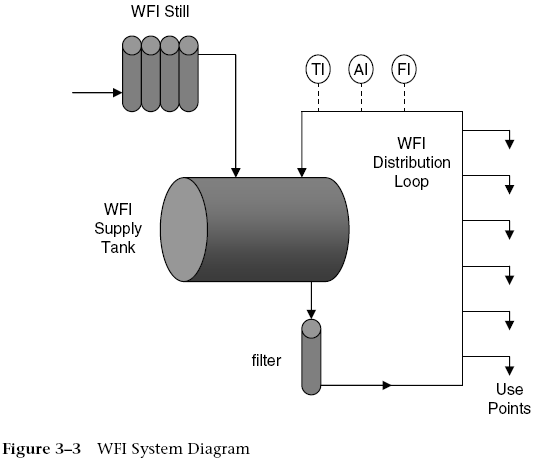
Typical instrumentation focuses on temperature at key locations in the
storage and distribution area. If there is a distribution loop, the return
water temperature is often taken as the lowest temperature point on the
loop, and used for validation purposes.
Temperature
Since temperature must be maintained throughout the WFI distribution
system, it is critical that temperature measurements be made throughout.
This includes temperature measurement at the WFI generator, inside any
WFI storage tanks, throughout the circulating loop, and at any temperature-
controlled drop points.
To minimize the process impact of temperature probe maintenance, all
temperature probes should be placed in thermo wells. RTDs are most
often used, although thermocouples may also be used.
Conductivity and pH
As confirmation of WFI system purity, conductivity or pH sensors may be
included in the distribution system. When specifying these devices, care
must be taken to ensure that they are designed to withstand the high
temperatures associated with WFI loops. Maintenance of these probes
may be an issue, so you may want to consider piping designs that allow
for isolation and removal of the probes without requiring re-sanitization
of the WFI system.
Flow
Flow measurement may be required to confirm continuous flow through
the WFI system. The simplest approach is to include a flow switch in the
design. However, a flow measurement will provide better information for
troubleshooting.
Due to the low conductivity of WFI, Mag flow meters are not a good
choice. Mass flow meters are most often recommended.

Communications
The WFI distribution system is usually connected to most other parts of
the process operation, so communications must be carefully designed. It
is a good idea to identify system boundaries by drawing them on a set of
P&IDs. In the case of WFI, you should define whether the distribution
valve will be managed by the WFI distribution system or by the receiving
process system. For temperature-controlled WFI drops, the temperature
control is usually a part of the receiving process system.
Alarms and failures of the WFI system can have far-reaching consequences.
Consider passing on high-level WFI alarms to the process system
controllers or HMIs. This will allow operators to react quickly, preventing
the propagation of incidents throughout the process.
Sequences
There are generally two sequences involved in WFI distribution. They are
sanitization and distribution.
During sanitization, the storage and distribution temperatures are
increased, and held at a high temperature for some period of time. Some
systems are designed with process interlocks to prevent the use of WFI
until after the completion of the sanitization step.
During distribution, the WFI is circulated, and process systems may draw
from the WFI loop. Since multiple systems may draw at once, it is important
to maintain flow in all parts of the WFI loop. This may involve
adjustments to supply flow rate or restrictions on the number of concurrent
users. Since the users are likely isolated from each other, the restrictions
on concurrent users may be handled with process interlocks.
Control Loops
WFI generation is typically instrumented with temperature and pressure
controls. This may also include cascaded controls to steam flow or heater
elements.
WFI distribution control loop requirements are generally quite simple.
The process requirements are to maintain flow and temperature in the
system. For small systems, the flow control loop can be avoided by properly
sizing the supply pump. For larger WFI systems, flow control is best
handled through the use of a variable-speed supply pump.
The specific flow requirement is to maintain speed of fluid flow through
the entire distribution loop. This may be expressed as maintaining a minimum
Reynold's Number of 20,000 throughout the system. The total flow
is highest at the outlet of the supply pump, then falls as users take WFI at
each of their drops. Measuring flow at the end of the distribution loop, as
it returns to the supply tank, provides the most conservative estimate of
flow in the distribution loop.
Calculations
A simple timer can be used to calculate the time since last sanitization.
Tuneables
Sanitization temperature, operating temperature, and minimum flow rate
may be subjects of debate within your company. It is a good idea to allow
for these values to be changed simply during commissioning, then locked
down for qualifications.