The bio-pharmaceutical industry demands exacting detail in design, development,
operation, quality, and just about every other aspect of the business.
As such, there is a degree of specialty in most every field of endeavor
in this industry. This book was developed to try to accelerate the learning
process for the application of automation in bio-pharmaceuticals. The
authors' hope is that the content of this book will help scientists and engineers
continue to contribute to the manufacture of high-quality medicines
via improving process control and on-line availability of information
while reducing costs, cycle time, and process variability.
Some readers may come into this industry with previous automation
experience. Others may be in the bio-pharmaceutical industry, but have
limited automation knowledge. In either case, the authors strived to bring
the reader to a more thorough understanding of the topics.
This book is supplemented by a wealth of reference materials in the industry.
Each chapter contains a list of recommended reference materials.
 TABLE OF CONTENTS
 Chapter 3.3.1 - Typical CIP Instrumentation Requirements
CIP system instrumentation typically serves two purposes. The first, its
regulatory function, is to maintain control of the process, so that the
appropriate cleaning solutions are delivered at the appropriate conditions.
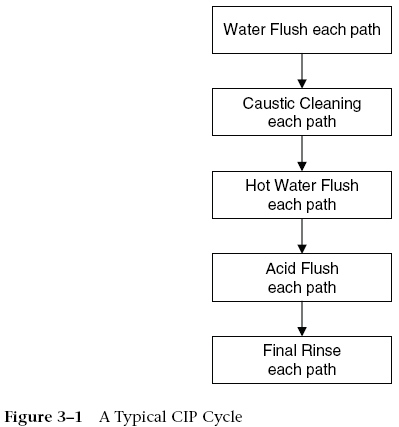
The second is to provide proof that all cleaning steps have been acceptably
performed. This second function helps to identify equipment failures,
and ensure that a system will not be considered "clean" unless the
instrumentation indicates that all expected conditions have been met.
Temperature
Temperature control is important to the delivery of CIP fluids. As mentioned
above, low-temperature water may be needed to flush proteinaceous
substances from process lines and vessels. Warm or hot water may
be needed to dissolve and flush salts or other materials.
In CIP applications, temperature is most commonly measured using RTDs
or thermocouples. Thermo wells are commonly used to reduce direct
exposure of the temperature sensor to the process fluid. This also allows
for easy access to the device for calibration and maintenance purposes.
Temperature measurement may also be an integral part of the confirmation
strategy. Many instruments used for confirmation (such as conductivity
meters) must be temperature-compensated to ensure an accurate
reading. In these cases, an integral temperature measurement may be
included with the meter.
Pressure and/or Flow
Pressure and flow measurements are primarily used for confirmation of
cleaning. To ensure proper cleaning of process fluids, it is important to
maintain turbulent flow of liquid in the process piping. This is usually
accomplished quite easily with an appropriately sized pump. A flow meter
may be used to confirm that the flow remains in a turbulent flow regime.
Pressure indication is often used to confirm adequate supply to a
sprayball. Most sprayballs are designed to deliver a given flow at a given
pressure. Sprayball performance may be confirmed with either pressure or
flow during the cleaning development activities.
Conductivity and/or Concentration
Conductivity and/or concentration measurements are typically used for
confirmation of cleaning. Conductivity meters are useful because they
can accurately determine the concentration of the ionic cleaning fluids,
and detect the relatively non-conductive purified water. They are most
often employed in measuring the downstream cleaning/waste fluid, to
ensure completion of the CIP cycle. However, they may also be used
upstream, to confirm the concentration of the newly-prepared cleaning
solution.
Toroidal conductivity meters are most often used in CIP applications. This
is because they are less likely to develop a build-up of waste material, and
are not sensitive to this build-up.
When applying conductivity meters, it is important to ensure that the
meter is adequately immersed in process fluid. A partially-submerged
meter will produce noisy and erroneous readings. This is most often
accomplished by carefully choosing the location for installation of the
meter in the CIP return/waste piping. The meter will typically be
mounted in a vertical upward-flowing pipe.
Tank Weights
It is important to prevent "pooling" of cleaning solutions within process
tanks. Pooling may result in a "bathtub ring" forming along the walls of
the tank being cleaned. It may be difficult or impossible to remove the
bathtub ring through CIP cleaning alone.
Weigh cells are typically used to measure tank weights. In fact, most process
tanks will be outfitted with weigh cells. Incorporating the existing
weight measurement into the CIP cycle can help to reduce the possibility
of liquid pooling.
Also, cleaning fluid supply tank weights are often used for the preliminary
mixing of cleaning fluids. Use of totalized weight may be more accurate
than a ratio blending of concentrated cleaning solution and water. In any
case, the applications are very similar to the typical weigh cell described
in Chapter 2.