Data Quality: The Field Guide
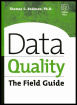
This guide provides the practical guidance needed to start and advance a data quality program.
 TABLE OF CONTENTS
 There are certain technical skills that are absolutely essential if an organization is to effectively manage and improve data quality. These include the following:
Understanding customer needs (Chapter 17 ). After all, if customers are the final arbiters of quality, it pays to understand what they want.
Measurement of actual quality levels against requirements (Chapters 18 and 19 ).
Controls (gasp!) to keep errors from leaking through to customers (Chapter 20).
Statistical control (double gasp!!) to make future performance predictable. In particular, to know that future errors will be prevented (Chapter 21 ).
Quality improvement to close the most important gaps between actual and required performance (Chapter 22 ).
Quality planning to set targets for improvement and to design new information chains (Chapters 23 and 24 ).
Five of these tasks are among the ten elements of successful second-generation data quality systems.
This section describes how these tasks are accomplished. As noted, they are the essential skills of data quality management and improvement, and...