Small Antenna Design

Keeping mathematics to the absolute minimum, this guide describes the theory behind effective small antenna design while providing design techniques and examples for small antennas for different operating frequencies.
 TABLE OF CONTENTS
 Small is obviously a comparative term, and so one must ask what is the reference standard. For ordinary usage, we may use as reference the middle of the size range of objects in the class being discussed. For example, among dogs a dachshund is small and a St. Bernard is large. But the medium dog is small compared to the medium human, whether we re talking about height or weight. For antennas, it s hard to say what the middle size is, so people talk ordinarily in reference to the human scale. I call this physical size. That is, an antenna that fits in your hand is physically small, while one that is 20 m tall is physically large. Physical size, along with the environment in which the antenna will be used, is very important in the mechanical design of an antenna, but it is only secondary to the electrical design process.
The scale of interest for electrical design is the free-space wavelength at the operating frequency. From physics, we know
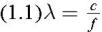
where c = speed of light, f = frequency, and ? = wavelength. Generally speaking, an antenna is considered electrically small if its largest dimension is at or under ?/10. If f is in MHz, it is convenient to use c = 300 Mm/s, because then ? is in m. At the middle of the AM broadcast band, f = 1 MHz, so ? = 300...