Small Antenna Design

Keeping mathematics to the absolute minimum, this guide describes the theory behind effective small antenna design while providing design techniques and examples for small antennas for different operating frequencies.
 TABLE OF CONTENTS
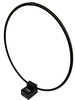
 In Chapters 2 and 3 we examined the single-turn small loop, one of the two fundamental antenna types. It is a kind of dual to the small dipole. The loop has a conducting path for current back to the source, whereas the dipole s current is reflected back from an open end. When both antennas are vertical they have vertical polarization, but the loop has a figure-8 azimuth pattern and a constant-level elevation pattern, while the dipole has a constant-level azimuth pattern and a figure-8 elevation pattern, all considered in free space. The loop is inductive rather than capacitive, and its radiation resistance depends on its area in square wave-lengths, rather than its length. All of these differences make the loop more useful than the dipole in some applications, mostly receiving.
In this chapter we consider the single-turn loop, the solenoid or uniform helix (which may be thought of as several loops in series or an N-turn loop), the contrawound toroidal helix (CTHA), and an example of a folded antenna. We study them mainly in transmit mode, and defer coils wound on ferrite cores to the chapter on receiving antennas.
Like the dipole, the small loop has a high reactance that can be reduced by designing it to occupy more of the available space. We present modeling methods and results for a doughnut, a sheet barrel, and a thick-walled barrel. Going in the opposite direction, the solenoid clearly has more inductance and should have more radiation resistance than the...