Small Antenna Design

Keeping mathematics to the absolute minimum, this guide describes the theory behind effective small antenna design while providing design techniques and examples for small antennas for different operating frequencies.
 TABLE OF CONTENTS
 The field expressions for the vertical dipole and horizontal loop given in Chapter 2 are simple because they happen to be in the best orientation in the spherical coordinate system for the purpose. For practical reasons, it is useful to have field expressions for other orientations in the same coordinate system. Specifically, in this appendix I show how to find the expressions for a horizontal dipole on the x axis and a vertical loop in the x- z plane. The method is to express the starting expression in terms of ( x, y, z) coordinates, relabel the axes to simulate rotation of the antenna, and then convert the result back to angle coordinates. To do this, we need to express unit vectors from one system in terms of those of another. This is shown in the next section.
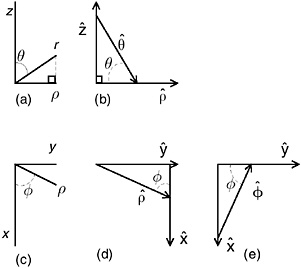
Figure 2.1 in Chapter 2 shows spherical ( r, ?,  ), cylindrical ( ?, , z), and rectangular ( x, y, z) coordinate systems. To get the relations we need, I take sections of this figure as shown in Figure A.1. Figure A.1(a) shows the vertical plane at , the ( ?, z) plane. ? is the projection of r into the ( x, y) plane. The variable relations we need from this figure are: