Small Antenna Design

Keeping mathematics to the absolute minimum, this guide describes the theory behind effective small antenna design while providing design techniques and examples for small antennas for different operating frequencies.
 TABLE OF CONTENTS
 In Chapter 2, equations (2.3) and (2.4) give the electromagnetic fields due to a source on the z axis at the origin of coordinates. In Appendix A, we find what happens for various re-orientations of the source. In this Appendix, we find how to deal with a source moved away from the origin. Figure B.1 shows a field point at  and a source point at
  . The distance between them is the line R. The propagation part of the field expression is:

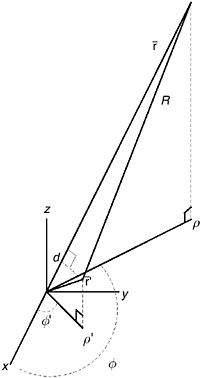 and source point at .
The parallel-ray approximation is that the field point is so far away from both the origin and the source point that the lines for r and R are essentially parallel. This leads to:

where d is the length of the projection of on . This is the vector dot product of with the unit vector for .

Now replacing R with r d in (B.1),

The result has the propagation function based at the origin, an amplitude-shift factor, and a phase-shift factor. Because d is tiny compared to r, usually the d/ r term is dropped. However, ?d may be a significant angle and so the phase term is kept in cases where this is true or where it makes the small difference between large subtracted terms.
B.1 Suppose there are two...