Smithells Metals Reference Book, Eighth Edition
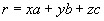
Metals and alloys, like most condensed matter, are aggregates of crystals; they are built up of units, consisting of small groups of atoms regularly and indefinitely repeated throughout the body by parallel translations. If the co-ordinates of the atoms within such a group are given, then three independent translations represented by vectors a, b, c, which are not all parallel to the same plane, suffice to specify the position of any other atom in the crystal. Let the vector from an arbitrary origin to an atom be
then atoms of the same kind will be found at all points
where n 1 , n 2, n 3 may be any positive or negative integers. Such a succession of regularly arranged points in space constitutes a space lattice.
The lattice may be regarded either as a system of translations relating identical points in a structure, or as a system of points arranged in parallel and equidistant nets, each net consisting of series of parallel and equidistant rows in which the points are spaced at equal distances. The points of such an array can be arbitrarily arranged in an infinite number of ways in parallel equidistant linear rows or planar nets; they can, in other words, be referred to an infinite number of systems of three primitive vectors, but investigation has shown that any structure possessing the symmetry observed in crystals can be referred to one of 14...