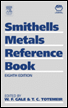
Smithells Metals Reference Book, Eighth Edition
Chapter 23: Sintered Materials

A wide range of useful metallic materials is made from powder by the process known as sintering. Such materials are commonly referred to as sintered materials, and individual engineering components made by the process are known as sintered parts, sintered components, or PM parts PM or P/M being the acronym for powder metallurgy.

23.1 The PM Process

This process consists of shaping the powder by means of pressure in a die or mould of prescribed shape; the compact thus formed must have sufficient green strength to allow it to be removed from the die and handled without fracture. This is an important property. After removal from the die, the compact is heated, normally in a protective atmosphere or vacuum, to a temperature usually below the melting point, such that the particles weld together and in some cases densify markedly to increase the strength. This is the step known as sintering. In some cases, especially when the sintered compact is to be subsequently rolled or extruded, isostatic compaction in a flexible mould is used. An exception to the compaction process is the production of filter elements from spherical powders, often of bronze, by what is known as loose powder sintering, in which powder is poured into a mould of the appropriate shape and sintered in the mould. Most recently shaping has embraced injection moulding and the use of polymers to lubricate the powder flow into a mould cavity. After moulding, the polymer is extracted and the powder is sintered to near full...

UNLIMITED FREE
ACCESS
TO THE WORLD'S BEST IDEAS

SUBMIT
Already a GlobalSpec user? Log in.

This is embarrasing...

An error occurred while processing the form. Please try again in a few minutes.

Customize Your GlobalSpec Experience

Category: Powder Compacting Equipment
Finish!
Privacy Policy

This is embarrasing...

An error occurred while processing the form. Please try again in a few minutes.