Smithells Metals Reference Book, Eighth Edition
Chapter 12: Gas-Metal Systems

12.1 The Solution of Gases in Metals

The gases which can be found in solution in measurable quantities in metals are the diatomic gases hydrogen, nitrogen and oxygen and also the noble gases in Group 8 of the Periodic Table.

12.1.1 Dilute Solutions of Diatomic Gases

A diatomic gas dissociates on solution so that equilibrium between the solute and the gas phase is written:


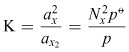
In systems where no gas metal compounds are formed and where also the solute does not contribute to the stability of the metallic phase, solutions are usually so dilute that Henry's law applies. If, also, the ideal gas laws are assumed for the gas phase and the standard states selected are (1) the infinitely dilute atomic fraction for the solute and (2) the pure element at a standard pressure for the gas, the equilibrium constant is given by:

(12.1)

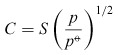
where a x and are the activities of the solute and the diatomic gas, N x is the atomic fraction of solute and p is the pressure of the gas. In a form rearranged to express the proportionality between the solute concentration, C, and the square root of the gas pressure, p, equation (12.1) is known as Sievert's relation:

(12.2)

where S is the solute concentration in equilibrium with the standard pressure, .

Values for solubilities in dilute solutions are usually presented as solute concentrations in equilibrium with the pure gas at one atmosphere pressure (101 325 Pa). The...

UNLIMITED FREE
ACCESS
TO THE WORLD'S BEST IDEAS

SUBMIT
Already a GlobalSpec user? Log in.

This is embarrasing...

An error occurred while processing the form. Please try again in a few minutes.

Customize Your GlobalSpec Experience

Category: Chemical Process and Petrochemical Gases
Finish!
Privacy Policy

This is embarrasing...

An error occurred while processing the form. Please try again in a few minutes.