Smithells Metals Reference Book, Eighth Edition
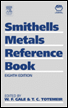
Chapter 17: Radiative Properties of Metals

Overview

The ability of a surface to radiate energy is governed by the material of which the surface is composed and its physical condition. Any attempt, therefore, to place a numerical value on its radiating ability must be related to a definition of the surface condition. It is usual to choose smooth polished surfaces for this purpose and thus arrive at values which are comparable from one metal to another.

A perfect radiator (blackbody) provides a standard of comparison for defining the radiating ability of any other body or surface by determining the ratio of the emission of the surface to that of a blackbody when they are at the same temperature. An examination of the ratios thus obtained shows that the radiating ability of a metal surface varies with wavelength, temperature and angle of emission. The definition of the emittance, as this ratio is called, must therefore take into account these variations.

DEFINITIONS OF EMITTANCE

Spectral, directional emittance, ? ?, of a surface is the ratio of the energy emitted over an infinitesimally small wavelength range at wavelength ? into a specified direction, per unit area of the surface, to the energy emitted by a unit area of a black surface at the same temperature. The emittance in a direction normal to the surface, called the normal, spectral emittance, ? n ?, is most commonly employed.

The spectral, hemispherical emittance, ? ?, is a directional average of the spectral, directional emittance, and gives the ratio...

UNLIMITED FREE
ACCESS
TO THE WORLD'S BEST IDEAS

SUBMIT
Already a GlobalSpec user? Log in.

This is embarrasing...

An error occurred while processing the form. Please try again in a few minutes.

Customize Your GlobalSpec Experience

Category: Spectroradiometers
Finish!
Privacy Policy

This is embarrasing...

An error occurred while processing the form. Please try again in a few minutes.