Telecommunications Signaling

Highlights the conventions of signalling systems and provides a detailed assessment of their architecture.
 TABLE OF CONTENTS
 Networks are extremely complex and an effective management system is needed to optimise the functions that can be performed. It is essential that operators can plan, provide and maintain services and networks, while reducing operational costs.
Network management includes gathering information, analysing the consequences of the information and taking appropriate actions. It includes:
Performance management, i.e. gathering statistics to enable the behaviour of the network to be evaluated. Performance management includes the collection of measurements, modifying equipment capacities and adjusting routing tables.
Fault management, i.e. detecting, isolating and correcting abnormal operation of the network. Fault management includes handling alarm conditions, activating measurements and taking corrective actions.
Configuration management, i.e. controlling resources within the network, allowing changes to the structure of the network, operating data, etc. in a flexible manner. Configuration management includes composing and verifying routing tables, installing link sets and initialising timers.
CCSS7 is a key part of telecommunications networks. More than this, it forms a signalling network in its own right. It is therefore essential that CCSS7 should have a comprehensive management capability. This Chapter briefly reviews the management aspects of CCSS7.
CCSS7 has three types of management capability, as illustrated in Fig. 10.1. The names of the types are not ITU-T standard and are used here to facilitate explanation.
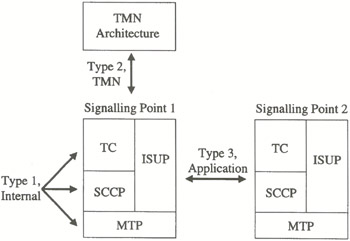
The first type (Internal Type) relates to the management functions specified as part of the signalling system itself. For example, the MTP...