Telecommunications Signaling

Highlights the conventions of signalling systems and provides a detailed assessment of their architecture.
 TABLE OF CONTENTS
 In response to increasingly demanding customer requirements, network operators throughout the world are implementing integrated services digital networks (ISDNs). These provide user-to-user connections using digital transmission links and nodes. ISDNs need responsive and efficient signalling systems, both within the network and for users to gain access to the network. In the past, international standards organisations concentrated on the specification of internodal signalling systems. However, the benefits of ISDNs can only be realised by users if the access signalling systems are similarly responsive. Flexible information transfer is required between users and the network, and directly between users. The Digital Subscriber Signalling System No.1 (DSS1)1 is defined to meet the demanding requirement of providing flexible access signalling for users.
DSS1 is responsible for transferring information between users and local nodes in both circuit-switched and packet-data applications. Chapter 3 describes the architecture of DSS1 (three layers). This Chapter describes the functions of the Physical and Data Link Layers of DSS1. Chapter 12 describes the functions of the Network Layer.
Layer 1 describes the physical, electrical and functional characteristics of the interface between the user and the local node (network). Access from a user to a local node in an ISDN is by one of two connection types: basic access and primary rate (multi-line) access. The basic access is shown in Fig. 11.1.
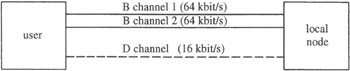
The transmission link between the customer (user) and the local node provides an information bit rate of 144 kbit/s. The bit rate...