Telecommunications Signaling

Highlights the conventions of signalling systems and provides a detailed assessment of their architecture.
 TABLE OF CONTENTS
 As mentioned in Chapter 13, private network signalling systems evolved to take advantage of the feature-rich nature of PABXs before the advent of virtual private networks (VPNs). A successful system was the Digital Private Network Signalling System (DPNSS). This Appendix gives a brief outline of such a private network signalling system. The system is based on three layers, similar to those of DSS1. This Appendix focuses on the Layer 3 aspects.
In private networks, the switching functions are performed by PABXs, as illustrated in Fig. A6.1. In this case, users are connected to PABXs 1 and 2. PABXs 3,4 and 5 form a transit network.
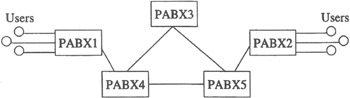
A typical message format contains a Message Type Field and one or more Information Element Fields, as illustrated in Fig. A6.2.
| Information Element | Information Element | Information Element | Message Type |
The Message Type indicates the category of the message, e.g.:
Service Request;
Incoming Call Indication;
Call Accepted;
Release Request.
In some cases, the Message Type is sufficient to define the action that is required. In other cases, Information Elements are provided to give additional information. Typical Information Elements are given in Table A6.1.
| Information Element | Description |
|---|---|
| Service Indicator | type of service, e.g. telephony |
| Calling Line Category | type of line, e.g. ordinary extension |
| Originating Line Identity | number of calling user |
| Destination Line Identity | number of called user |
Private network signalling systems, in common with their...