Telecommunications Signaling

Highlights the conventions of signalling systems and provides a detailed assessment of their architecture.
 TABLE OF CONTENTS
 The File Transfer Protocol (FTP)6 fits within the Application Layer of the IP Model, as shown in Fig. 18.3. The objective of FTP is to transfer data files reliably and efficiently between ( a) a user and a server or ( b) between servers. The files are stored in the user and server file systems. These file systems vary in nature and FTP is designed to take account of these variations. Thus, the user is relieved of the burden of handling the variations.
FTP makes use of lower layers to transport information, typically TCP in conjunction with IP.
A model for the FTP applied to a user and a server is illustrated in Fig. 18.11. The model has two entities; a user and a server. Communication takes place between the entities over two types of connection. The Control Connection covers all aspects of controlling the file transfer, e.g. the user requesting a file to be transferred. The Data Connection provides the path over which the files, etc. are transferred.
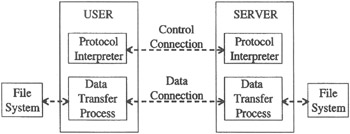
For control purposes, each entity has a Protocol Interpreter (PI). The PIs communicate over the Control Connection by means of Commands and Replies. The Commands specify the parameters for the data connection (e.g. the data port to be used and the transfer mode) and the nature of the file system operation (store, retrieve, etc.). Replies are given over the Control Connection in...