Telecommunications Signaling

Highlights the conventions of signalling systems and provides a detailed assessment of their architecture.
 TABLE OF CONTENTS
 The Address Resolution Protocol (ARP)1 fits within the Link Layer of the IP Model, as illustrated in Fig. 18.3.
A unit of data transferred between the Internet and Link Layers is termed an 'IP Packet'. The Address Resolution Protocol (ARP) translates an IP address for an outgoing IP Packet into the physical address of the destination point of the network. A typical physical network is an Ethernet, which is a means of connecting hosts to a cable at a standard bit rate.
The translations are held in a table listing all computers or users on a network. The translation table is filled with data as required. If a translation is not available for an IP Packet with a particular IP address, the IP Packet is stored or discarded and a procedure is invoked to determine the appropriate translation. The procedure is illustrated in Fig. 18.4.
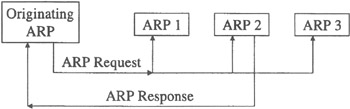
The originating ARP broadcasts an ARP Request Packet to all entities connected to the network. The broadcast packet includes the IP and physical addresses of the originating ARP and the IP address for which a translation is being sought.
Upon receipt of the broadcast packet, the ARP functions in each entity compare the IP Address given in the packet with their own IP address. In this example, ARP 2 has the IP address that is requested in the broadcast message. ARP 2 therefore returns an ARP Response Packet to the originating ARP.
The...