Telecommunications Signaling

Highlights the conventions of signalling systems and provides a detailed assessment of their architecture.
 TABLE OF CONTENTS
 Chapter 3 describes the tiered structure adopted by CCS systems in telecommunications networks. The IP signalling systems are also defined within a layered structure, which is illustrated in Fig. 18.1.
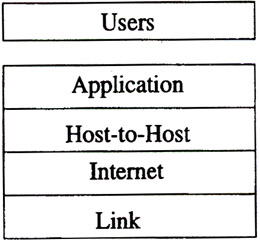
IP uses a four-tier structure, the tiers being called 'layers'. The Application Layer provides the interface to the users. It performs functions that are application-specific and provides data in a suitable format to be applied by the users.
A 'Host' is a node or computer that originates or terminates IP traffic. This is in contrast to nodes that forward IP traffic between hosts, which are known as Routers. A host, for example, allows users to communicate with other computers on a network. The IP Host-to-Host Layer provides a communication function between host computers. It is the role of this layer to facilitate the transfer of Application Layer data either by setting up end-to-end connections or by connectionless message transfer.
The Internet Layer is responsible for routing data across networks from one end-user to another.
The Link Layer hides the details of the network implementation from the higher layers by defining the physical and link-related characteristics of the network. The attributes of the physical wiring, data rates and methods of access are defined.
Readers familiar with the OSI Model explained in Chapter 3 will recognise strong similarities with the 4-Layer IP architecture. Further work is needed to ensure that a comprehensive alignment is achieved,...