Telecommunications Signaling

Highlights the conventions of signalling systems and provides a detailed assessment of their architecture.
 TABLE OF CONTENTS
 This Appendix gives a brief explanation of networks to assist in the understanding of the role of signalling,
Networks are built in a structured manner, with switches forming a hierarchy. A typical network is shown in Fig. A1.1.
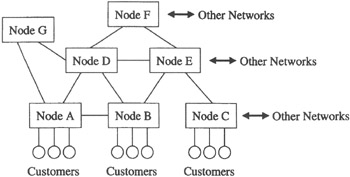
Whereas Fig. A1.1 gives a common structure for networks, the role of each node varies according to the application being considered. Examples are given below for telephony, broadband networks, mobile communications and IP networks.
For traditional telephony, Nodes A, B and C are local exchanges that provide customers with connections to the network. Each local exchange is connected to at least one transit exchange (Nodes D and E) and possibly other local exchanges. Node F is an international gateway and provides access to other countries. Both local and transit exchanges also provide access to other networks. Networks are extremely complex, both in terms of the technology needed to provide services and the operational support that is necessary to maintain effective working. Additional network elements are required to support these complexities and Node G is shown as an example of a database storing specialised information.
Future high-speed data services (broadband) will be based on the evolving asynchronous transfer mode (ATM) technologies. In this case, Nodes A, B and C are Edge ATM Nodes that provide access to the network. Nodes D, E and F are Transit ATM Nodes that provide information transfer capability to other Edge Nodes or to other networks, e.g. the...