Telecommunications Signaling

Highlights the conventions of signalling systems and provides a detailed assessment of their architecture.
 TABLE OF CONTENTS
 The Simple Network Management Protocol (SNMP)7 is designed to provide management capabilities in IP-based networks. SNMP facilitates the inspection and alteration of management information relating to a Network Element by a remote user. As its name implies, one aim of SNMP is to implement a simple approach to network management, avoiding complex procedures. In the future, more management capability will be required. This can be achieved by evolving SNMP. A more likely scenario is the adoption of a more rigorous framework.
Network Elements refer to entities like hosts, gateways and servers and the meaning is the same as described in Chapter 10. Management Agents are incorporated within the Network Elements to perform management functions. Network Management Stations execute management applications which monitor and control the Network Elements.
The SNMP is used to transfer management information between a Management Station and a Network Element. A simple architecture illustrating how SNMP fits within the management framework is given in Fig. 18.13.
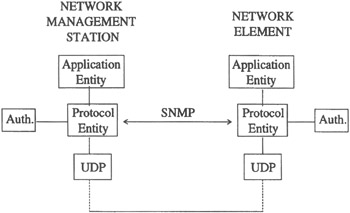
The Network Management Station and Network Element have Application Entities that drive the management functions and procedures. The Protocol Entities (PEs) transfer the management information necessary to support the Application Entities in their roles. The SNMP refers to the protocol between the PEs. Each PE has access to an Authentication Function that validates the identity of a message source.
To keep SNMP simple, it uses the services of the UDP, i.e. simple datagrams are transferred...