Telecommunications Signaling

Highlights the conventions of signalling systems and provides a detailed assessment of their architecture.
 TABLE OF CONTENTS
 The Telephone User Part (TUP)1 was defined for use in international and national telephony-based networks (including circuit-switched data). Options are specified to allow for special circumstances in national networks. The TUP is designed to cover all telephone applications, including use over satellites. The TUP is an effective system. However, the fact that it is designed primarily for telephony-based networks constrains its applicability. Working with, for example, non-circuit-related information transfer systems (e.g. Transaction Capabilities) is not as efficient as the ISDN User Part (ISUP) described in Chapter 6. The TUP is still in use, but it is being replaced by the more flexible ISUP.
TUP messages are carried by the MTP in Message Signal Units, the general format of which is described in Chapter 4. The format of a TUP Message Signal Unit is shown in Fig. A5.1.
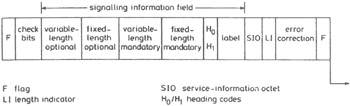
The User Part Information is included in the Signalling Information Field (SIF) of the message. The SIF contains a label, a heading code and one or more information elements (which can be mandatory or optional, according to the type of message). The length of the signal unit can be fixed or variable.
The Label is the information that the TUP uses to identify the traffic circuit to which a message refers. The label consists of the Routing Label and the Circuit Identification Code (CIC). The Routing Label specifies the identity of the originating and destination exchanges. The...