Gas Well Deliquification

7.8: Operation with Weak Wells

7.8 Operation with Weak Wells

Two methods are mentioned here using plunger lift for weak wells. One is the use of the casing plunger and the other is the use of a side string for gas injection.

7.8.1 Casing Plunger for Weak Wells

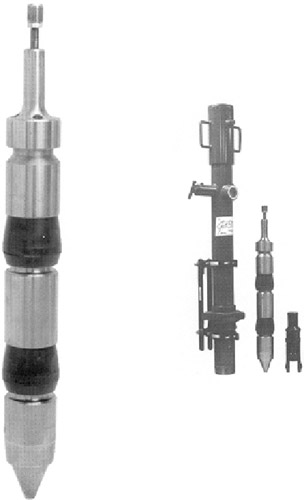
The casing plunger travels in the casing only, and there is no tubing in the well. The plunger senses when a head of liquid appears above the plunger, the internal bypass valve then closes, and the well gas production lifts the plunger and slug of liquid to the surface. Then at the surface, the plunger internal valve will open and the plunger will drop. The casing plunger rises and falls slowly. It has rubber cups that fit the casing. The cups will not last long enough for satisfactory service if the casing is very rough. Figure 7-17 shows a casing plunger.

Figures 7-18, 7-19, 7-20, and Table 7-2 are introduced to allow the sample calculation that follows to size cycle gas requirements for using a casing plunger. The calculations are from FBI (Tyler, TX) who no longer supply casing plungers. MULTI (Millersburg, OH) has been a supplier of casing plungers.


Figure 7-17: Casing plunger showing the rubber cups that seal against the casing ID and the lubricator and downhole casing stand (Multi Products Co, Millersburg, OH)

Figure 7-18: Casing plunger internals (FBI, Tyler, TX)

Figure 7-19: Casing plunger cycle design chart (FBI, Tyler, TX)

Figure 7-20: Casing plunger bbls/cycle vs. fluid head (FBI, Tyler, TX)
Table 7-2:

UNLIMITED FREE
ACCESS
TO THE WORLD'S BEST IDEAS

SUBMIT
Already a GlobalSpec user? Log in.

This is embarrasing...

An error occurred while processing the form. Please try again in a few minutes.

Customize Your GlobalSpec Experience

Category: Piston Pumps and Plunger Pumps
Finish!
Privacy Policy

This is embarrasing...

An error occurred while processing the form. Please try again in a few minutes.