Gas Well Deliquification

Chapter 14: Other Methods to Attack Liquid-Loading Problems

14.1 Introduction

Several methods for removing water from gas wells have been presented, and the methods have been classified under several broad categories. However, there are several existing methods and some new developments that merit discussion but do not fall neatly into any of the previous discussions.

This chapter contains information on:

  • Use of ESP cable to add thermal energy to the flowstream

  • Casing liners to reduce heat loss from the flowstream

  • Thermal coatings to reduce heat loss from the flowstream

  • Use of a vacuum in the casing-tubing annulus with a packer installed

  • Cycling

  • Tubing/annulus flow switching

  • Tubing flow controllers

  • Tubing inserts to re-integrate liquids into a mist-like flow

14.2 Thermal Methods for Water of Condensation

Chapter 1 discussed several sources of produced water from a gas well. When the water enters the wellbore as water vapor with the gas and condenses further up the wellbore, there are some methods that can be used to keep the water in the vapor phase and prevent condensation in the tubing.

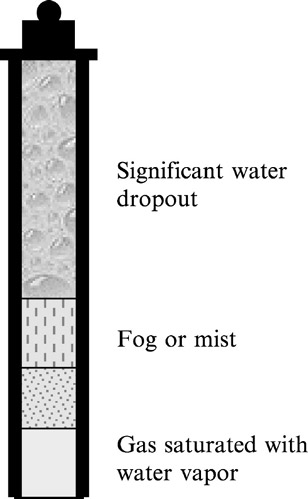
Figure 14-1 shows a gas well with water of condensation. Water enters the wellbore with the gas in the vapor phase and, depending on the pressure and temperature variation in the tubing, liquid water may condense out of the vapor phase if wellbore conditions drop below the dew point for the saturated gas.


Figure 14-1: Gas well with water of condensation

In the regions where liquid drops out, the pressure gradient will be higher than if the water remained in the vapor...

UNLIMITED FREE
ACCESS
TO THE WORLD'S BEST IDEAS

SUBMIT
Already a GlobalSpec user? Log in.

This is embarrasing...

An error occurred while processing the form. Please try again in a few minutes.

Customize Your GlobalSpec Experience

Category: Packer Elements
Finish!
Privacy Policy

This is embarrasing...

An error occurred while processing the form. Please try again in a few minutes.