Gas Well Deliquification

This Appendix summarizes the development of the Turner [1] equations to calculate the minimum gas velocity to remove liquid droplets from a vertical wellbore.
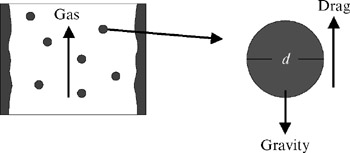
Consider gas flowing in a vertical wellbore and a liquid droplet transported at a uniform velocity in the gas stream as illustrated in Figure A-1.
The forces acting on the droplet are gravity, pulling the droplet downward, and the upward drag of the gas as it flows around the droplet.
The gravity force is:
and the upward drag force is given by:
where g = gravitational constant = 32.17 ft/s 2
g c = 32.17 lbm-ft/lbf-s 2
d = droplet diameter
? L = liquid density
? G = gas density
C D = drag coefficient
A d = droplet projected cross-sectional area
V G = gas velocity
V d = droplet velocity
The critical gas velocity to remove the liquid droplet from the wellbore is defined as the velocity at which the droplet would be suspended in the gas stream. A lower gas velocity would allow the droplet to fall, resulting in liquid accumulation in the wellbore. A higher gas velocity would carry the droplet upward to the surface and remove the droplet from the wellbore.
Thus, the critical gas velocity V Cis the gas velocity at which
or:
Substituting A d = ?d 2/4 and solving...