Gas Well Deliquification

Chapter 13: Progressive Cavity Pumps

13.1 Introduction

Introduced in 1936, the progressive cavity pump (PCP) is of simple design and has the ability to handle solids and viscous fluids required for many applications.

According to ABB, [1] there are approximately 60,000 PCP applications in the world with the most being in Canada and Venezuela. Many are used for de-watering coal bed methane production, primarily due to the solids handling ability, and other gas wells, as well for water and oil well production. For general de-watering of gas wells, PCPs might be recommended if:

  • Depth is shallow (<4000 to 6000 ft)

  • Fluid rates are relatively high

  • Low profile pumping system is required

  • Good power efficiency is sought

  • Solids are in the production

  • Well temperature is low

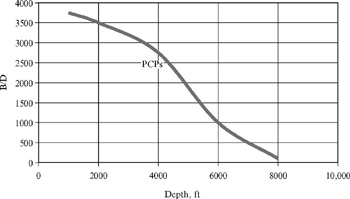
Figure 13-1 shows approximate depth-rate limitations for the PCP system.


Figure 13-1: An approximate depth-rate envelope for PCP system applications (Courtesy Weatherford.)

Figure 13-1 illustrates the design of the PCP. The pump has only one moving part downhole and no valves. The pump will not gas-lock, but the elastomeric stator can overheat handling gas. It can produce sandy and abrasive formation fluids and is not usually plugged by solids.

A PCP does have limitations. The rubber or elastomeric stator may be susceptible to chemical attack and high temperature and is generally limited to depths less than approximately 4000 to 6000 ft. Catalogs show PCP performance to 6000 to 7000 ft, and although possible, operational problems may be severe. A cross-section of the pump is shown in Figure 13-2, illustrating the...

UNLIMITED FREE
ACCESS
TO THE WORLD'S BEST IDEAS

SUBMIT
Already a GlobalSpec user? Log in.

This is embarrasing...

An error occurred while processing the form. Please try again in a few minutes.

Customize Your GlobalSpec Experience

Category: Artificial Lift Equipment
Finish!
Privacy Policy

This is embarrasing...

An error occurred while processing the form. Please try again in a few minutes.