Gas Well Deliquification

Gas lift is an artificial lift method whereby external gas is injected into the producing flowstream at some depth in the wellbore. The additional gas augments the formation gas and reduces the flowing bottomhole pressure, thereby increasing the inflow of produced fluids. For dewatering gas wells, the volume of injected gas may be designed so that the combined formation and injected gas will be above the critical rate for the wellbore. [1]
Although gas lift may not lower the flowing pressure as much as an optimized pumping system, several advantages make gas lift the artificial lift method of choice.
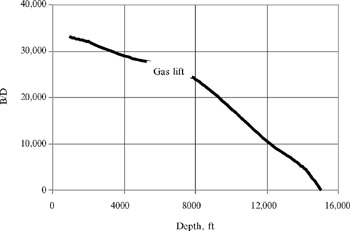
Of all artificial lift methods, gas lift most closely resembles natural flow and has long been recognized as one of the most versatile artificial lift methods. Because of its versatility, gas lift is a good candidate for removing liquids from gas wells under certain conditions. Figure 11-1 shows the approximate depth-pressure ranges for application of gas lift.
The most important advantages of gas lift over pumping lift methods are:
Most pumping systems become inefficient when the GLR exceeds some high value, typically approximately 500 scf/bbl(90m 3/m 3), because of severe gas interference. Although remedial measures are possible for conventional lift systems, gas lift systems can be directly applied to high GLR wells because the high formation GLR reduces the need for additional gas to lower the formation-flowing pressure.
Production of solids will reduce the life...