Linking Learning and Performance: A Practical Guide to Measuring Learning and On-the-Job Application
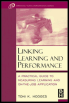
Provides a step-by-step approach for developing learning and performance measures and a method for analyzing and reporting results.
 TABLE OF CONTENTS
 Once learning measures are designed, the next step is to test them for reliability and validity. It is easy for the evaluator to get discouraged or intimidated when thinking of the seemingly daunting task of testing learning measures for reliability and validity. After all, doing so takes time and expertise, so it is often a step many test designers avoid. In addition, time and resources are constraints the test designer faces in most organizations. It is rare that resources are available to meet expectations of academicians for testing for reliability and validity, but there are practical steps that can be taken to help ensure tests are measuring what they are meant to and that test results are used in the most appropriate way. The methods offered in this chapter are practical give them a try.
If a learning measure is reliable, it is consistent over time. If learning has taken place, a reliable measure will yield the same student score on a second administration. The evaluator will want to do whatever possible to ensure testing measures are reliable, so that the scores for one test administration can be compared to those of subsequent administrations.
Sources of error due to the way in which the test is designed, which produce unreliable measures, include:
Differences in the interpretation of the results of the instrument
The length of the instrument
These errors can be reduced by designing tests that can be scored objectively and ensuring that...