Manufacturing Technology for Aerospace Structural Materials

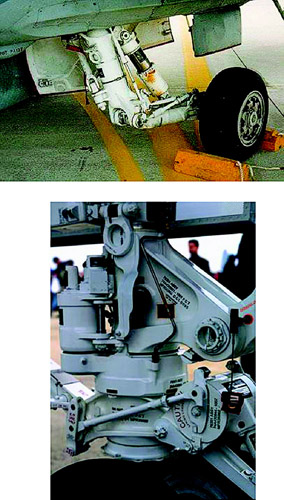
While high strength steels normally account for only about 5 15% of the airframe structural weight, they are often used for highly critical parts such as landing gear components, control surface hinges, and helicopter transmissions. The main advantages of high strength steels are their extremely high strengths and stiffness. Although high strength steels are often defined as those with a minimum yield strength of 200 ksi, there are steels capable of being heat treated to yield strengths exceeding 300 ksi. This can be extremely important in landing gear applications where it is critical to minimize the volume of the gear components, such as the one shown in Fig. 5.1. In addition, steel alloys have a modulus of elasticity of 28 29 msi, which allows landing gears to maintain their shape during hard landings. The disadvantages of high strength steels are primarily their high densities and susceptibility to brittle fracture. At a density of around 0.29lb/in 3, steel alloys are considerably heavier than other structural materials such as aluminum (0.1lb/in. 3) and titanium (0.16lb/in 3). Also, as a result of their high strength levels, they are susceptible to hydrogen embrittlement and stress corrosion cracking, both of which can cause sudden brittle failures.
Four types of high strength steels will be covered in this chapter: medium carbon low alloy steels, high fracture toughness steels, maraging steels, and precipitation hardening stainless steels. The medium carbon low alloy steels and high fracture toughness...