Manufacturing Technology for Aerospace Structural Materials

7.1: Materials

7.1 Materials

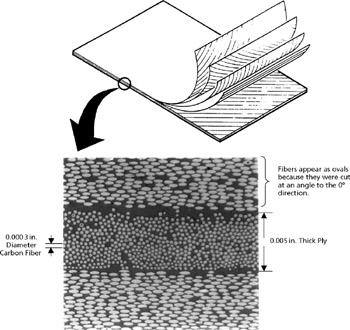
Continuous fiber composites are laminated materials (Fig. 7.4), in which the individual layers, plies, or lamina are oriented in directions that will enhance the strength in the primary load direction. Unidirectional (0 ) laminates are extremely strong and stiff in the 0 direction but are also very weak in the 90 direction because the load must be carried by the much weaker polymeric matrix. While a high strength fiber can have a tensile strength of 500 ksi or more, a typical polymeric matrix normally has a tensile strength of only 5 10 ksi. The longitudinal tension and compression loads are carried by the fibers, while the matrix distributes the loads between the fibers in tension, and stabilizes and prevents the fibers from buckling in compression. The matrix is also the primary load carrier for interlaminar shear (i.e., shear between the layers) and transverse (90 ) tension. Since the fiber orientation directly impacts the mechanical properties, it would seem logical to orient as many of the layers as possible in the main load carrying direction. While this approach may work for some structures, it is almost always necessary to balance the load-carrying capability in a number of different directions, such as the 0 , +45 , ?45 , and 90 directions.


Figure 7.4: Laminate Construction [1]

7.1.1 Fibers

The primary role of the fibers is to provide strength and stiffness; however, as a class, high strength fibers are brittle; posses linear stress strain behavior with little or no evidence of yielding; have low strain to...

UNLIMITED FREE
ACCESS
TO THE WORLD'S BEST IDEAS

SUBMIT
Already a GlobalSpec user? Log in.

This is embarrasing...

An error occurred while processing the form. Please try again in a few minutes.

Customize Your GlobalSpec Experience

Category: Synthetic Fibers and Fabrics
Finish!
Privacy Policy

This is embarrasing...

An error occurred while processing the form. Please try again in a few minutes.