Manufacturing Technology for Aerospace Structural Materials

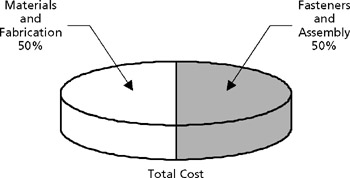
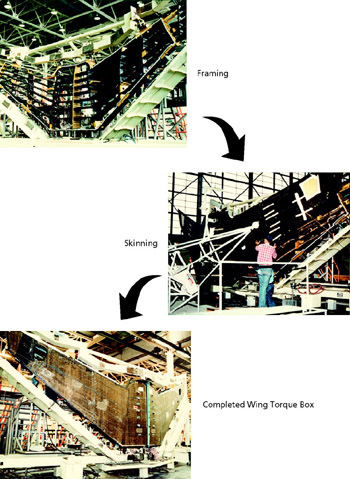
Assembly represents a significant portion of the total manufacturing cost. Assembly operations are labor intensive and involve many steps and, as shown in Fig. 11.1, can represent as much as 50% of the total delivered part cost. [1] For example, the wing shown in Fig. 11.2 requires:
A framing operation in which all of the spars and ribs must be located in their proper location and connected together with shear ties.
Each skin must then be located on the substructure, shimmed, holes drilled, and fasteners installed. During and after skin installation there are various sealing operations that must be performed.
The final wing torque box must have the leading edges, wing tips, and control surfaces assembled.
Source: The Boeing company
This brief description is a gross over-simplification of the complexity involved in assembling a large structural component. The number of mechanical fasteners in a typical fighter aircraft might be in the range of 200 000 300 000, while a commercial airliner or transport aircraft can have as many as 1 500 000 3 000 000 fasteners, depending on aircraft size. A hole has to be drilled for each of these fasteners and then the fastener has to be installed in each hole. In this chapter, the basic assembly operations will be covered with an emphasis on hole preparation and the types of mechanical fasteners used in aircraft structures.
[1]Taylor, A., "RTM Material Developments for Improved Processability...