Manufacturing Technology for Aerospace Structural Materials

This appendix provides some definitions, or explanations, of some of the important mechanical properties and environmental degradation mechanisms that can occur in structural materials. It should be pointed out that these are very brief explanations, often simplified, and that much more extensive explanations can be found in texts dedicated to these subjects.
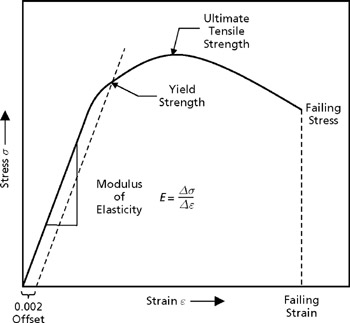
The tensile properties of a material are determined by applying a tension load to a specimen and measuring the elongation or extension. A typical stress strain curve for a metal is shown in Fig. C-1. The load can be converted to engineering stress ( ?) by dividing the load by the original cross-sectional area of the specimen.
where
| P | = load in lb |
| A o | = original cross-sectional area in in. [2] |
The engineering strain ( ?) can be calculated dividing the change in gage length by the original gage length.
where
| l | = gage length |
| l 0 | = original gage length |
As shown in Fig. C-1, the ultimate tensile strength is the maximum stress that occurs during the test. For metals without a definite yield point, the yield strength is determined by drawing a straight line parallel to the initial straight line portion of the stress strain curve. The line is normally offset by a strain of 0.2% (0.002). Yield strength is generally a more important design parameter than ultimate strength, since the possibility of plastic yielding is unacceptable for almost all structures.