Manufacturing Technology for Aerospace Structural Materials

Filament winding is a high rate process in which a continuous fiber band is placed on a rotating mandrel. Lay-down rates as high as 100 400 lb/h are not uncommon. It is also a highly repeatable process that can fabricate large and thick-walled structure. Filament winding is a mature process, having been in continuous use since the mid-1940s. It can be used to fabricate almost any body of revolution, such as cylinders, shafts, spheres, and cones. Filament winding can also fabricate a large range of part sizes; parts smaller than 1 in. in diameter (e.g., golf club shafts) and as large as 20 ft in diameter have been wound. The major restriction on geometry is that concave contours cannot be wound, because the fibers are under tension and will bridge across the cavity. Typical applications for filament winding are cylinders, pressure vessels, rocket motor cases, and engine cowlings. End fittings are often wound into the structure producing strong and efficient joints.
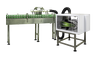
A typical filament winding process is shown in Fig. 7.21. Dry tows are drawn through a bath containing liquid resin, collimated into a band, and then wound on a rotating mandrel. [10] To deliver the fiber tows from the spool to the part requires that the band pass through a series of guides, redirects, and spreader bars. During the entire delivery process, tension on the tows is minimized to preferably 1 lb or less. Low tension helps to reduce abrasion to the fibers, minimizes the possibility...