Manufacturing Technology for Aerospace Structural Materials

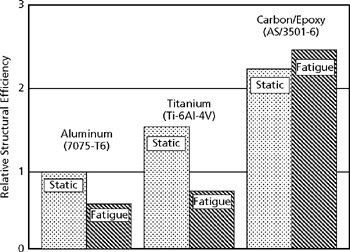
The advantages of high performance composites are many, including lighter weight; the ability to tailor lay-ups for optimum strength and stiffness; improved fatigue strength; corrosion resistance; and with good design practice, reduced assembly costs due to fewer detail parts and fasteners. The specific strength (strength/density) and specific modulus (modulus/density) of high strength fiber composites, especially carbon, are higher than other comparable aerospace metallic alloys. This translates into greater weight savings resulting in improved performance, greater payloads, longer range, and fuel savings. A comparison of the overall structural efficiency of carbon/epoxy, Ti-6Al-4V, and 7075-T6 aluminum is given in Fig. 7.1.
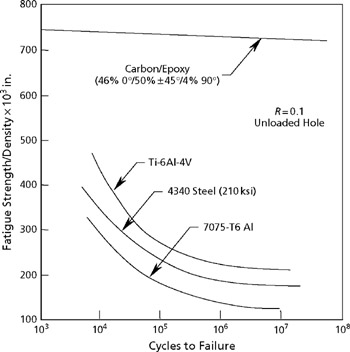
Composites do not corrode and their fatigue resistance is outstanding. Corrosion of aluminum alloys is a major cost, and a constant maintenance problem, for both commercial and military aircraft. The corrosion resistance of composites can result in major savings in supportability costs. The superior fatigue resistance of composites, compared to high strength metals, is shown in Fig. 7.2. As long as reasonable design strain levels are used, fatigue of carbon fiber composites should not be a problem.
Assembly costs usually account for about 50% of the cost of an airframe. Composites offer the opportunity to significantly reduce the amount of assembly labor and fasteners. Detail parts can be combined into a single cured assembly, either during initial cure or by secondarily adhesive bonding.
Disadvantages of composites include high raw material costs and high...