Manufacturing Technology for Aerospace Structural Materials

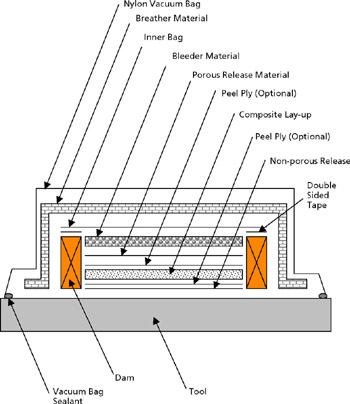
After ply collation, the laminate is sealed in a vacuum bag for curing. A typical bagging schematic is shown in Fig. 7.27. To prevent resin from escaping from the edges of the laminate, dams are placed around the periphery of the lay-up. Typically, cork, silicone rubber, or metal dams are used. The dams should be butted up against the edge of the lay-up to prevent resin pools from forming between the laminate and dams. The dams are held in place with either double-sided tape or Teflon pins.
A peel ply may be applied directly to the laminate surface if the surface is going to be subsequently bonded or painted. Then, a layer of porous release material, usually a layer of porous glass cloth coated with Teflon, is placed over the lay-up. This layer allows resin and air to pass through the layer without having the bleeder material bond to the laminate surface. The bleeder material can be a synthetic material (e.g., polyester mat) or dry fiberglass cloth, such as 120 or 7781 style glass. The amount of bleeder material depends on the laminate thickness and the desired amount of resin to be removed. For the newer net resin content prepregs, bleeder cloth is not required since it is not necessary to remove any excess resin.
After the bleeder is placed on the lay-up, an inner bag made of Mylar (polyester), Tedlar (PVF), or Teflon (TFE) is placed over the lay-up.