Manufacturing Technology for Aerospace Structural Materials

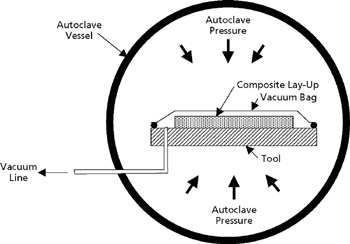
Autoclave curing is the most widely used method of producing high quality laminates in the aerospace industry. An autoclave works on the principle of differential gas pressure, as illustrated in Fig. 7.29. The vacuum bag is evacuated to remove the air, and the autoclave supplies gas pressure to the part. Autoclaves are extremely versatile pieces of equipment. Since the gas pressure is applied isostatically to the part, almost any shape can be cured in an autoclave. The only limitation is the size of the autoclave, and the large initial capital investment to purchase and install an autoclave. A typical autoclave system, shown in Fig. 7.30, consists of a pressure vessel, a control system, an electrical system, a gas generation system, and a vacuum system. Autoclaves lend considerable versatility to the manufacturing process. They can accommodate a single large composite part, such as a large wing skin, or numerous smaller parts loaded onto racks and cured as a batch. While autoclave processing is not the most significant cost driver in total part cost, it does represent a culmination of all the previously performed manufacturing operations, because final part quality (per ply thickness, degree of crosslinking, and void and porosity content) is often determined during this operation.
Autoclaves are normally pressurized with inert gas, usually nitrogen or carbon dioxide. Air can be used, but it increases the danger of a fire within the autoclave during the heated...