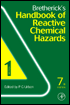
Bretherick's Handbook of Reactive Chemical Hazards, Volume 1, Seventh Edition
See ACETYLENIC COMPOUNDS
See Aziridine: Silver
See Bromine azide
See 3-Bromopropyne: Metals
Koffolt, J. H., private comm., 1965
Silver is incompatible with oxalic or tartaric acids, since the silver salts decompose on heating. Silver oxalate explodes at 140 C, and silver tartrate loses carbon dioxide.
See other METAL OXALATES
See Chlorine trifluoride: Metals
See Ethylene glycol: Silvered copper wire
Britz, W. K. et al., Chem. Abs., 1975, 83, 150293
Causes of spontaneous combustion and other hazards of silver zinc batteries were investigated.
Luchs, J. K., Photog. Sci. Eng., 1966, 10, 334
Action of silver on nitric acid in presence of ethanol may form the readily detonable silver fulminate.
See Nitric acid: Alcohols
See also SILVER-CONTAINING EXPLOSIVES
See Ethyl hydroperoxide: Silver
See Ethylene oxide: Reference 4
See Hydrogen peroxide: Metals
Grignard, 1935, Vol. 3, 320
In contact with finely divided (reduced) silver, incandescence occurs.
Yoshida, 1980, 103
MRH values for 7 combinations, largely with catalytically susceptible materials, are given.
See OZONIDES
See Peroxomonosulfuric acid: Catalysts
See Peroxyformic acid: Metals
See other METALS
Popov, E. I. et al., Chem. Abs., 1977, 87, 205143
Popov,...