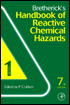
Bretherick's Handbook of Reactive Chemical Hazards, Volume 1, Seventh Edition
Appendix 2: Tabulated Fire-Related Data

Compounds which are considered to be unusually hazardous in a fire context because of their low flash points (below 25 C) or auto-ignition temperatures (below 225 C) are included in the table. The names used are those titles in the text of Section 1 which are prefixed with a dagger. Synonyms may be found either in Section 1 or in the alphabetical index of chemical names and synonyms in Appendix 4. Boiling points are given for those compounds boiling below 50 C.

The figures for flash points are closed-cup values except where a suffix (o) indicates the (usually higher) open-cup value. The figures for explosive limits (or flammability limits) are % by volume in air at ambient temperature except where indicated otherwise. Where no figure has been found for the upper limit, a query has been inserted. Figures for auto-ignition temperatures are usually those determined in glass (without catalytic effects) except where stated.

Most of the values are those quoted in the references given in the topic entries:

  • AUTOIGNITION TEMPERATURES

  • FIRE

  • FLAMMABILITY

  • FLASH POINTS

Name

Formula

B.P./ C

Fl.P./ C

E.L./%

A.I.T./ C

Arsine

AsH 3

-62

flammable

Diborane

B 2H 6

-93

-90

0.9 98

38 52

Pentaborane(9)

B 5H 9

30

0.4 ?

35

Bromosilane

BrH 3Si

2

< 0

ambient

Tribromosilane

Br 3HSi

112

flammable

ambient

Hydrogen cyanide

CHN

25.7

-18

6.0 41

Dichloromethane

CH 2Cl 2

39.7

calc-9

12.0 19.0

605

Difluoromethane

CH 2

-51

13 27

Formaldehyde

CH 2O

-19

-19

7.0 73

UNLIMITED FREE
ACCESS
TO THE WORLD'S BEST IDEAS

SUBMIT
Already a GlobalSpec user? Log in.

This is embarrasing...

An error occurred while processing the form. Please try again in a few minutes.

Customize Your GlobalSpec Experience

Category: Industrial Gases
Finish!
Privacy Policy

This is embarrasing...

An error occurred while processing the form. Please try again in a few minutes.