Bretherick's Handbook of Reactive Chemical Hazards, Volume 1, Seventh Edition
Marsh, F. D. et al., J. Amer. Chem. Soc., 1965, 87, 1819
Ittel, S. D. et al., Inorg. Chem., 1975, 14, 1183
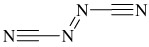
The solid explodes when mechanically shocked or heated in a closed vessel [1]. Preparative methods are hazardous because of the need to heat the explosive precursor, cyanogen azide [1,2].
See CYANONITRENE
See other DIAZO COMPOUNDS, CYANO COMPOUNDS

Marsh, F. D. et al., J. Amer. Chem. Soc., 1965, 87, 1820
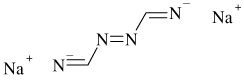
The radical anion salt is an explosive powder.
See related DIAZO COMPOUNDS, CYANO COMPOUNDS

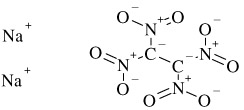
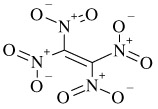
See Potassium 1,1,2,2-tetranitroethanediide
See other POLYNITROALKYL COMPOUNDS

Godovikova, T. L., Mendeleev Comm., 1993, (5) 209
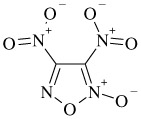
This oxygen rich explosive is claimed to be the first pernitro heterocycle known.
See other FURAZAN N-OXIDES, C NITRO COMPOUNDS

Schischkow, A., Ann. Chim. [3], 1857, 49, 310
Parker, C. O. et al., Tetrahedron, 1962, 17, 79, 84
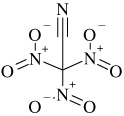
It explodes if heated quickly to 220 C [1]. It is also a friction- and impact-sensitive explosive, which may be used conveniently in carbon tetrachloride solution to minimise handling problems [2].
See other CYANO COMPOUNDS, POLYNITROALKYL COMPOUNDS

Baum, K, et al.,