The Finite Element Method for Fluid Dynamics, Sixth Edition
It is clear that the application of standard Galerkin discretization to the steady-state scalar convection-diffusion equation in several space dimensions is similar to the problem discussed previously in Sec. 2.2.1 in one dimension and will again yield unsatisfactory answers with high oscillation for local Peclet numbers greater than unity.
The equation now considered is the steady-state version of Eq. (2.8), i.e.
Obviously the problem is now of greater practical interest than the one-dimensional case so far discussed, and a satisfactory solution is important. Again, all of the possible numerical approaches we have discussed are applicable.
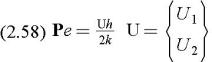
The most obvious procedure is to use again some form of Petrov-Galerkin method of the type introduced in Sec. 2.2.2 and Eqs (2.24) to (2.29), seeking optimality of ? in some heuristic manner. Restricting attention here to two dimensions, we note immediately that the Peclet parameter
is now a vector quantity and hence that upwinding needs to be directional .
The first reasonably satisfactory attempt to do this consisted of determining the optimal Petrov-Galerkin formulation using ? W * based on components of U associated to the sides of elements and of obtaining the final weight functions by a blending procedure. [10], [11]
A better method was soon realized when the analogy between balancing diffusion and upwinding was established, as shown in Sec. 2.2.3. In two (or three) dimensions the convection is only...