The Finite Element Method for Fluid Dynamics, Sixth Edition
Chapter 9: Generalized Flow Through Porous Media

9.1 Introduction

Flow through saturated porous media has been recognized as a fluid dynamics topic which has applications in a variety of engineering fields including seepage through soil, concrete, insulating media and packed beds; flows in heat exchangers and alloy solidification; and cooling of electronic components. Several books on porous media flow and heat transfer have been published covering both analytical and numerical solution methodologies. [1], [2], [3], [4]

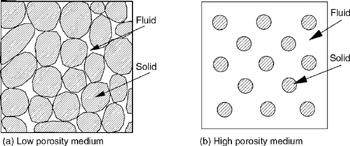
It appears that the usage of porous media flow model is divided into two parts. In the first of these we generally consider materials of low porosity (Figure 9.1(a)) and relate a priori by physical law the quantity of flow passing through all the pores in the appropriate coordinate directions. Here we find that at low velocities, as generally occur here, the relationship is linear and the quantity of the flow is related linearly to the pressure gradient. Thus, we generally write that (Darcy's law [5])


Figure 9.1: Typical examples of porous media.

where u i are the average velocity components, ? is the dynamic viscosity of the fluid and ? is permeability expressed in m 2. The permeability may be directional and in such situations, ? will be a tensor. We now concentrate on the balance of total quantities and consider a unit volume of porous medium to which we apply the mass conservation (incompressible flow) ? u i/ ? x i = 0. Using directly the linear...

UNLIMITED FREE
ACCESS
TO THE WORLD'S BEST IDEAS

SUBMIT
Already a GlobalSpec user? Log in.

This is embarrasing...

An error occurred while processing the form. Please try again in a few minutes.

Customize Your GlobalSpec Experience

Category: Dewatering Equipment
Finish!
Privacy Policy

This is embarrasing...

An error occurred while processing the form. Please try again in a few minutes.