The Finite Element Method for Fluid Dynamics, Sixth Edition
In the first chapter we have written the fluid mechanics equations in a very general format applicable to both incompressible and compressible flows. The equations included that of energy which for compressible situations is fully coupled with equations for conservation of mass and momentum. However, of course, the equations, with small modifications, are applicable for specialized treatment such as that of incompressible flow where the energy coupling disappears and to the problems of shallow water equations where the variables describe a somewhat different flow regime. Chapters 4 to 6 and 10 deal with such specialized forms.
The equations have been written in Chapter 1 in fully conservative, standard form [Eqs (1.25) and (1.26a) (1.26d)] but all the essential features can be captured by writing the three sets of equations as below.
Mass conservation
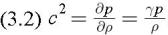
where c is the speed of sound and depends on E, p and ? and, assuming constant entropy,
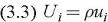
where ? is the ratio of specific heats equal to c p/c ?, where c p is the specific heat at constant pressure and c ? is the specific heat at constant volume, and we define the mass flow flux as
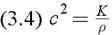
For a fluid with a small compressibility
in which K is the elastic bulk modulus. Depending on the application we use an appropriate relation for c [2].
Momentum conservation
Energy conservation
In all of the above u i are the velocity components, ? is the...