The Finite Element Method for Fluid Dynamics, Sixth Edition
Appendix E: Convection-Diffusion Equations Vector-Valued Variables

E.1 The Taylor-Galerkin method used for vector-valued variables

The only method which adapts itself easily to the treatment of vector variables is that of the Taylor-Galerkin procedure. Here we can repeat the steps of Sec. 2.7 but now addressed to the vector-valued equation with which we started Chapter 2 [Eq. (2.1)]. Noting that now ? has multiple components, expanding ? by a Taylor series in time we have


where ? is a number such that 0 ? ? ? 1.

From Eq. (2.1),


and differentiating


In the above we can write


where A i ? ? F i/ ? ? and if Q = Q( ?, x) and ? Q/ ? ? = S,


We can therefore approximate Eq. (E.1) as


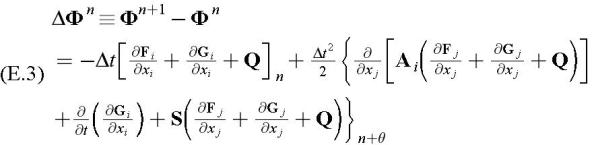
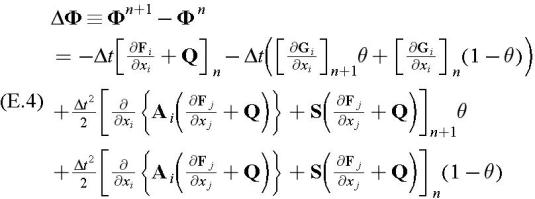
Omitting the second derivatives of G i and interpolating the n + ? between n and n + 1 values we have


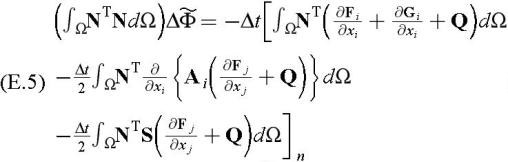
At this stage a standard Galerkin approximation is applied which will result in a discrete, semi-implicit, time-stepping scheme. As the explicit form is of particular interest we shall only give the details of the discretization process for ? = 0. Writing as usual


we have


This can be written in a compact matrix form similar to Eq. (2.107) as


in which, with


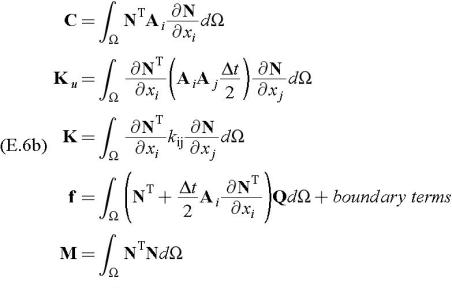
we have (on omitting the third derivative terms and the effect of S) matrices of the form of Eq. (2.108), i.e.


With ? =...

UNLIMITED FREE
ACCESS
TO THE WORLD'S BEST IDEAS

SUBMIT
Already a GlobalSpec user? Log in.

This is embarrasing...

An error occurred while processing the form. Please try again in a few minutes.

Customize Your GlobalSpec Experience

Category: I/Q Modulators and I/Q Demodulators
Finish!
Privacy Policy

This is embarrasing...

An error occurred while processing the form. Please try again in a few minutes.