The Finite Element Method for Fluid Dynamics, Sixth Edition
In the Taylor-Galerkin process, the Taylor expansion in time precedes the Galerkin space discretization. First, the scalar variable ? is expanded by the Taylor series in time [69], [77]
From Eq. (2.75) we have
and
Substituting Eqs (2.122a) and (2.122b) into Eq. (2.121) we have
Assuming U and k to be constant we have
Inserting Eq. (2.122a) into Eq. (2.124) and neglecting higher-order terms
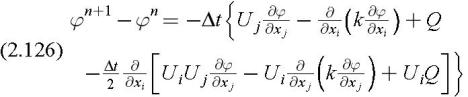
As we can see the above equation, having assumed constant U and k, is identical to Eq. (2.98) derived from the characteristic approach. Clearly for scalar variables both characteristic and Taylor-Galerkin procedures give identical stabilizing terms. Thus selection of a method for a scalar variable is a matter of taste. However, the sound mathematical justification of the characteristic-Galerkin method should be emphasized here and for this reason the characteristic Galerkin procedure forms the fundamental basis for the remainder of this text.
The Taylor-Galerkin procedure for the convection-diffusion equation in multidimensions can be written as
again showing the complete similarity with the appropriate characteristic-Galerkin form and identity when U i and k are constant. The Taylor-Galerkin method is the finite element equivalent of the Lax-Wendroff method developed in the finite difference context. [75]
The Taylor-Galerkin process has one important feature. The idea can be used directly for dealing with the vector form of the convection-diffusion equation, such as we have mentioned at the beginning of this chapter [viz. Eq. (2.1)]. This method...