The Finite Element Method for Fluid Dynamics, Sixth Edition
The procedures developed in the previous sections are in principle of course available for both linear and non-linear problems (with explicit procedures of time stepping being particularly efficient for the latter). Quite generally the convective part of the equation, i.e.
will have the vector U i dependent on ?. Thus
In the one-dimensional case with a scalar variable we shall have equations of the type
corresponding to waves moving with a non-uniform velocity U. A typical problem in this category is that due to Burger, which is defined by
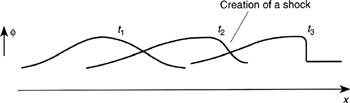
In Fig. 2.19 we illustrate qualitatively how different parts of the wave moving with velocities proportional to their amplitude cause it to steepen and finally develop into a shock form. This behaviour is typical of many non-linear systems and in Chapter 7 we shall see how shocks develop in compressible flow at transonic and supersonic speeds.
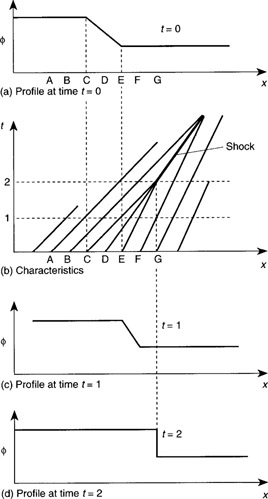
To illustrate the necessity for the development of the shock, consider the propagation of a wave with an originally smooth profile illustrated in Fig. 2.20(a). Here as we know the characteristics along which ? is constant are straight lines shown in Fig. 2.20(b). These show different propagation speeds intersecting at time t = 2 when a discontinuous shock appears. This shock propagates at a finite speed (which here is the average of the two extreme values).