The Finite Element Method for Fluid Dynamics, Sixth Edition

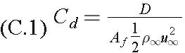
The drag force is the resistance offered by a body which is equal to the force exerted by the flow on the body at equilibrium conditions. The drag force arises from two different sources. One is from the pressure p acting in the flow direction on the surface of the body (form drag) and the second is due to the force caused by viscosity effects in the flow direction. In general the drag force is characterized by a drag coefficient, defined as
where D is the drag force, A f is the frontal area in the flow direction and the subscript ? indicates the free stream value. The drag force D contains the contributions from both the influence of pressure and friction, i.e.
where D p is the pressure drag force and D f is the friction drag force in the flow direction. The pressure drag, or form drag, is calculated from the nodal pressure values. For a two-dimensional problem, the solid wall may be a curve or a line and the boundary elements on the solid wall are one dimensional with two nodes if linear elements are used. The pressure may be averaged over each one-dimensional element to calculate the average pressure over the boundary element. If this average pressure is multiplied by the length of the element, then the normal pressure acting on the boundary element is obtained. If the pressure force is multiplied by the direction cosine...