The edge-based data structure has been used in many recent finite element formulations for flow problems. As mentioned in Sec. 7, Chapter 7, this formulation has many advantages such as smaller storage, etc. To explain the formulation we shall consider the Euler equations and a few assembled linear triangular elements on a two-dimensional finite element mesh as shown in Fig. F.1. From Eq. (1.25) we rewrite the following Euler equations
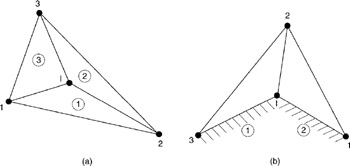 Figure F.1: Typical patch of linear triangular elements: (a) inside node; (b) boundary node.
 where ? are the conservative variables. If the element-based formulation for the above equation omits the stabilization terms, the weak form can be written as
In a fully explicit form of solution procedure, the left-hand side becomes M( ??/ ? t) and here M is the consistent mass matrix (see Chapter 3). We can write the RHS of the above equation for an interior node I [Fig. C.1(a)] by interpolating F i in each element and after applying Green's theorem as
where A E is the area and I, J and K are the three nodes of the element (triangle) E. This is an acceptable added approximation which is frequently used in the Taylor-Galerkin method (see Chapter 2). In another form, the above RHS can be written as [Fig. F.1(a)]
where A 1, A 2 and A 3 are the areas of elements 1, 2 and 3 respectively. For integration over the...
Copyright O.C. Zienkiewicz, R.L. Taylor and P. Nithiarasu 2005 under license agreement with Books24x7

 TABLE OF CONTENTS